For many travellers, Tehran comes as a surprise. It is not simply a city of monuments or politics. It is a city of layered history, crowded bazaars, mountain views, old cafés, refined cultural memory, and neighbourhoods where Persian civilisation still feels alive in everyday life. The streets move between chaos and elegance with remarkable ease. One moment brings tiled mosques and bookshops, the next brings flyovers, traffic, glass towers, and late-night cafés filled with students and artists.
India has no exact equivalent to Tehran. The histories are different, the scale is different, and the urban rhythm is different. Yet there are Indian cities where traces of the same Persianate world still survive. In architecture, language, food, markets, court culture, and public life, these cities carry echoes of the same civilisational network that once connected India and Iran for centuries.
Hyderabad
If one Indian city comes closest to recalling Tehran in atmosphere and cultural memory, it is Hyderabad.
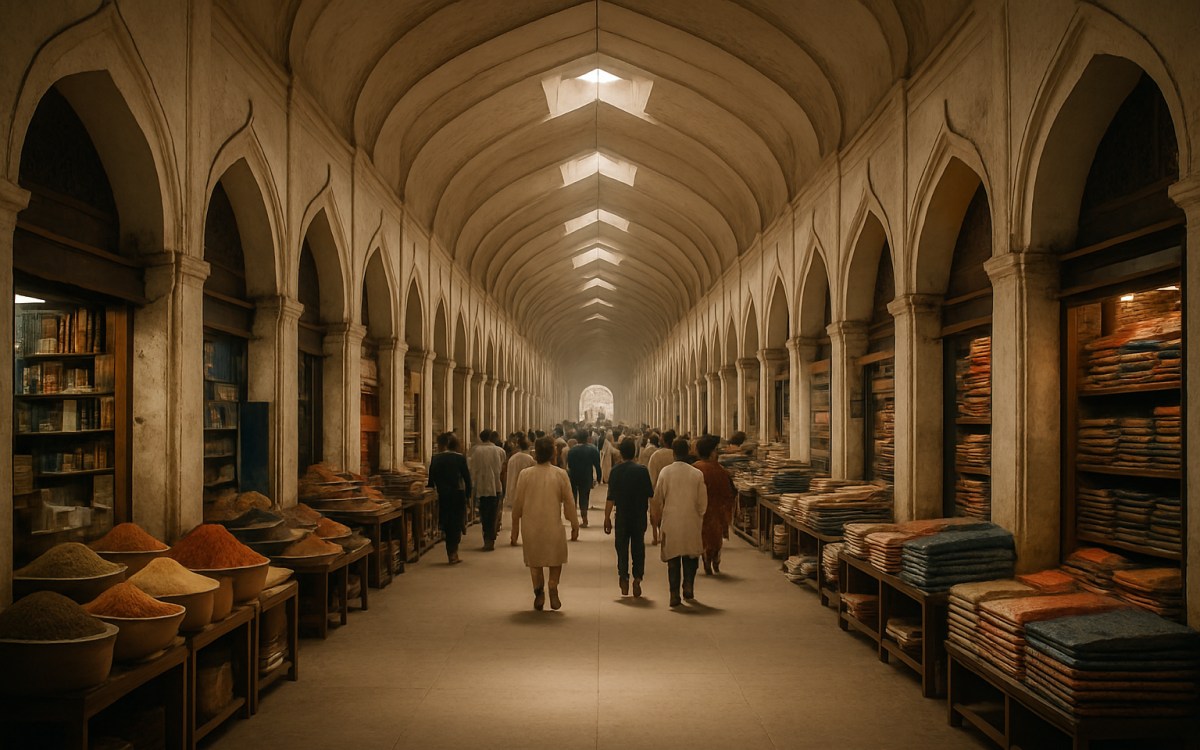
The resemblance begins in the old city. Around Charminar, the dense lanes of traders, perfume sellers, jewellery shops, tea houses, and food stalls immediately evoke the energy of Tehran’s Grand Bazaar. Neither space functions merely as a market. They are social ecosystems where commerce, conversation, religion, and daily life merge into one continuous urban rhythm.
The Persian influence in Hyderabad was not accidental. The Qutb Shahi rulers and later the Nizams cultivated strong Iranian cultural connections. Persian functioned as an administrative and court language for centuries, shaping literature, architecture, and elite culture across the city.
Even today, that legacy remains visible in surprising ways. Hyderabad’s famous Irani cafés feel culturally connected to Tehran’s café tradition. These are not hurried coffee chains built for speed. They are slow spaces built around discussion, newspapers, politics, poetry, and long conversations over tea. The old cafés around Abids, Himayatnagar, and the Charminar district preserve a distinctly Iranian social style that many Indian cities no longer possess.
Architecturally too, Hyderabad often feels closer to West and Central Asia than to much of southern India. Domes, arches, courtyards, stucco ornamentation, and monumental gateways create a skyline shaped by Indo-Persian aesthetics.
Like Tehran, Hyderabad is also a city of contrasts. Historic quarters exist beside aggressive modern expansion. Technology parks and luxury towers rise not far from centuries-old neighbourhoods where life still unfolds at a slower pace.
Lucknow
Lucknow resembles Tehran less in physical appearance and more in temperament.
Both cities possess a refined urban culture built around etiquette, poetry, literature, and intellectual life. Tehran’s literary cafés and artistic circles find an Indian parallel in Lucknow’s deeply cultivated tradition of conversation, hospitality, and courtly sophistication.
The Persian connection in Lucknow runs extremely deep. The Nawabs of Awadh maintained strong cultural ties with Iran, especially through Shia religious traditions. Persian artistic and architectural influence shaped many of the city’s grand structures, from gateways and imambaras to ornamental detailing and spatial planning.
Walking through older parts of Lucknow, one notices the same sense of faded grandeur visible in parts of Tehran. There are labyrinthine lanes, old mansions, courtyards hidden behind modest facades, and neighbourhoods where history survives not as a museum piece but as lived reality.
The resemblance also appears in food culture. Tehran’s dining tradition values slow meals, layered flavours, hospitality, and social dining rather than speed and convenience. Lucknow operates in much the same way. Meals are tied to memory, lineage, and ceremony.
What makes Lucknow especially comparable to Tehran is the city’s emotional texture. Both cities carry a consciousness of cultural decline while still fiercely preserving older traditions. There is pride, nostalgia, and a visible attachment to heritage in everyday life.
Delhi
Delhi and Tehran resemble each other because both are imperial capitals shaped by repeated waves of conquest, reinvention, and political power.
Few cities in India display the Persian imprint as clearly as Delhi. Under the Delhi Sultanate and the Mughal Empire, Persian became the language of administration, scholarship, diplomacy, and elite culture.
This influence transformed not only language but also urban design. Mughal Delhi absorbed Persian ideas of gardens, symmetry, water channels, domes, calligraphy, and ceremonial planning. Areas around Jama Masjid, Humayun’s Tomb, and Shahjahanabad still reveal this architectural worldview.
Like Tehran, Delhi also contains multiple historical eras layered over one another. Ancient ruins coexist beside colonial boulevards, modern infrastructure, crowded markets, embassies, universities, and elite residential districts. The city often feels fragmented yet strangely unified by its historical weight.
Old Delhi especially recalls parts of Tehran. The dense commercial lanes, traditional eateries, wholesale bazaars, and old religious quarters create a similar urban intensity. There is noise, congestion, negotiation, and sensory overload, but also extraordinary continuity with the past.
At the same time, both cities are deeply political. Government institutions, diplomatic communities, intellectual circles, journalists, activists, and students shape public life in visible ways. Conversations about culture and politics spill naturally into cafés, universities, and public spaces.
Srinagar
Srinagar offers a quieter and more poetic connection to Tehran.
The resemblance lies partly in landscape. Tehran sits beneath the Alborz Mountains, while Srinagar rests within the Kashmir Valley surrounded by the Himalayas. Both cities possess a dramatic relationship with mountains, changing seasons, and tree-lined landscapes.
More importantly, Kashmir absorbed strong Persian cultural influences over centuries. Persian literature, art, calligraphy, and court traditions flourished in the region for a long period. Mughal gardens in Kashmir were heavily inspired by Persian garden design, with geometric layouts, terraces, flowing water, and carefully framed natural scenery.
Walking through Srinagar’s older districts, one notices another similarity with Tehran: the coexistence of beauty and melancholy. Both cities carry visible memories of political turbulence, yet everyday life continues through markets, family spaces, food traditions, and artistic practices.
There is also a shared appreciation for aesthetics in ordinary life. Wooden architecture, gardens, tea culture, textiles, and traditional crafts all occupy an important place in Srinagar’s identity, much as they do in Iran.
Unlike Hyderabad or Delhi, Srinagar does not mirror Tehran’s urban scale or modern energy. Instead, it recalls the quieter cultural side of Iran that survives in smaller historic cities beyond the capital.
Mumbai
At first glance, Mumbai appears entirely different from Tehran. One is coastal and commercial, the other inland and political. One looks outward to the Arabian Sea, the other toward mountains and the Iranian plateau.
Yet certain parts of Mumbai strongly evoke Tehran’s cosmopolitan spirit.
The connection comes largely through the city’s long Iranian and Parsi presence. Across South Mumbai, old Irani cafés, bakeries, restaurants, and community spaces preserve an unmistakable Iranian imprint. These cafés are among the clearest cultural bridges between India and Iran.
Much like Tehran’s café culture, these spaces traditionally attracted writers, students, office workers, artists, and political thinkers. They were informal public institutions where ideas circulated freely over tea and food.
Neighbourhoods such as Fort, Byculla, and Marine Lines also carry traces of the layered urban identity seen in Tehran. Colonial buildings stand beside older commercial quarters, religious structures, crowded streets, and modern financial districts.
What truly connects Mumbai and Tehran is their complexity. Both cities are emotionally exhausting yet deeply compelling. They are ambitious, crowded, unequal, intellectual, and culturally restless. Beneath the traffic and concrete lies a strong memory of migration, trade, and cultural exchange that shaped both urban worlds.
For travellers who look beyond monuments and tourist brochures, these five Indian cities reveal how deeply connected India and Iran once were. The similarities are not superficial. They come from centuries of shared artistic traditions, courtly culture, language, architecture, trade, and migration across the Indo-Persian world.