India is a country that defeats generalisation. Its cities do not merely coexist; they contradict each other, argue with each other, and occasionally astonish each other. Most travel itineraries orbit the same seven or eight names: the obvious, the iconic, the ones that appear in every listicle and bucket list. There is nothing wrong with those cities. Mumbai is extraordinary. Jaipur is breathtaking. Kolkata will rearrange your understanding of what a city can feel like.
But India’s cultural life does not begin and end at its famous addresses. Across the subcontinent, in cities that don’t appear on most foreign itineraries, and sometimes don’t appear on domestic ones either, there are medieval forts, ancient cave monasteries, living craft traditions, Mughal gardens, and street food cultures that have been quietly thriving for centuries.
This article is about those cities. Seven that the world already knows, and 27 that deserve to be known. Some are industrial cities with unexpected heritage. Some are pilgrimage towns that double as wine country. Some are dismissed as suburbs of more famous neighbours but carry histories that predate those neighbours by centuries.
All of them are worth your time.
Part One: The Seven Icons
These are the cities that have already earned their place on the map. Their inclusion here is not to retread familiar ground, but to offer a frame. Understanding what makes these cities iconic helps you understand what you are missing when you skip the nineteen that follow.
Mumbai
The city that contains multitudes
Mumbai is not one city. It is a dozen cities stacked on top of each other, each one jostling for space on a narrow strip of land that was once seven islands. The Mumbai of Dharavi, the largest informal settlement in Asia and one of the most productive, exists minutes from the Mumbai of Malabar Hill, where bungalows overlook the Arabian Sea. The city of Bollywood exists alongside the city of the dabbawalas, whose lunch-delivery logistics have been studied by Harvard Business School.
What makes Mumbai iconic is not any single landmark but its relentless aliveness, the sense that the city is always mid-sentence, always mid-argument, always mid-transformation. The Victorian Gothic buildings of Fort, the Art Deco apartments of Marine Drive, and the colonial heritage of Chhatrapati Shivaji Maharaj Terminus all form the backdrop to a city that has never stopped moving.
Kolkata
The city of intellect and melancholy
Kolkata carries its history more visibly than almost any other Indian city. Its colonial architecture is crumbling in the most beautiful way: the peeling plaster, the faded indigo, the buildings that look like they are slowly becoming the earth they stand on. Beneath the nostalgia lies one of India’s sharpest intellectual cultures: a city of Nobel laureates, of some of the finest bookshops in the subcontinent, of adda, the Bengali art of prolonged, argumentative, passionate conversation over tea.
The Durga Puja festival transforms Kolkata every October into something with no real parallel anywhere in the world. The entire city becomes an open-air art installation, with thousands of elaborately crafted pandals, or temporary temples, competing for the most inventive interpretation of the goddess.
Best time to visit: October to November for Durga Puja. December to February for comfortable walking weather.
Agra
More than the marble
Everyone comes for the Taj Mahal. Fewer people linger long enough to discover what surrounds it. Agra Fort, a UNESCO World Heritage Site in its own right, is a sprawling complex of royal apartments, audience halls, and private mosques that tells the story of the Mughal empire from its heights to its end. Shah Jahan died in Agra Fort, imprisoned by his son Aurangzeb, looking out at the Taj Mahal he had built for his wife. The view from his tower window is one of the most poignant in India.
The city’s artisan tradition, marble inlay work, leather goods, and petha sweet-making, has continued uninterrupted for four centuries. Agra deserves more than a sunrise visit and a departure.
Best time to visit: October to March. Avoid May and June, when temperatures regularly exceed 45°C and the Taj Mahal’s white marble becomes almost impossible to approach by midday.
Hyderabad
The city of pearls and biryani and something more
Hyderabad is the only city in India that can credibly claim to have invented its own cuisine and made the world come to it. Hyderabadi biryani, cooked dum-style, sealed with dough, the rice and meat layered and slow-cooked together, is not merely a dish but a cultural argument about what Mughal cooking became when it met the Deccan. Irani chai, double ka meetha, and haleem during Ramzan make Hyderabad’s food culture a semester-long course in itself.
Beyond the food is a city of remarkable architectural range: the Charminar and its surrounding bazaars, Golconda Fort with its acoustic engineering (a handclap at the entrance can be heard at the summit), the Nizam’s palaces, and the newer city that has become one of India’s technology capitals without entirely surrendering its older character.
Best time to visit: October to February. Summers are punishing, and monsoon from June to September can be intense.
Chennai
The keeper of classical South India
Chennai is the cultural custodian of Carnatic music, Bharatanatyam dance, and Tamil classical literature, a city whose relationship with its own heritage is unusually deliberate and conscious. The December music season, Margazhi, sees hundreds of concerts and dance performances across the city for an entire month, drawing audiences from across the Tamil diaspora.
The city’s temples, particularly the Kapaleeshwarar Temple in Mylapore, are not museum pieces but living institutions of daily ritual and festival. Mylapore itself, one of the oldest urban neighbourhoods in the world, rewards walking: its flower markets, silk shops, and kolam-decorated thresholds are an unbroken thread to a city that existed long before the British arrived.
Best time to visit: November to February. The city gets the northeast monsoon in October and November, which can be heavy; December onwards is ideal.
Jaipur
The Pink City
Jaipur was designed. In 1727, Maharaja Jai Singh II planned the city on a grid, based on ancient Vedic architecture principles, and painted its central buildings a particular terracotta pink to welcome the Prince of Wales in 1876. The colour stuck. The walled old city, itself a UNESCO World Heritage Site, contains the City Palace, the Jantar Mantar (a 300-year-old astronomical observatory that still functions), and the Hawa Mahal, the latticed facade of 953 windows that allowed royal women to observe street life without being seen.
Jaipur’s craft traditions, block printing, blue pottery, gem cutting, and lac jewellery, are not tourist performances but working industries that employ the city’s artisan communities generation after generation.
Best time to visit: October to March. Summers are extremely hot; the monsoon, from July to September, brings some relief, and crowds thin out.
Bangalore
The garden city that grew into a tech metropolis
Bangalore holds two identities in creative tension: the colonial-era garden city of broad avenues, British bungalows, and the country’s finest microbrewery culture; and the modern technology capital that houses the Indian operations of nearly every major global tech company. Cubbon Park and Lalbagh Botanical Garden are extraordinary green lungs in the centre of the city. Bangalore Palace, modelled loosely on Windsor Castle, sits improbably in the middle of one of the most congested urban areas in Asia.
What distinguishes Bangalore culturally is its unusual openness: a city of migrants from across India and the world, which has produced a food scene, a music scene, and a literary culture that reflect that cosmopolitanism.
Part Two: The 27 You Haven’t Planned For
These are the cities this article is really about. Some are well known to Indian travellers but rarely appear on international itineraries. Some are unknown to almost everyone. All of them have a cultural or heritage story that justifies a detour, or, in several cases, an entire trip.
1. Ahmedabad
India’s first UNESCO World Heritage City
In 2017, Ahmedabad became the first city in India to receive the UNESCO World Heritage City designation, a recognition of its remarkable walled old city, which has been continuously inhabited for over 600 years. The pol houses, dense, interlocking residential neighbourhoods built around shared courtyards, are an extraordinary piece of urban design: cool in summer, secure, communal, with carved wooden facades that record centuries of craftsmanship.
The step-wells, or vav, are perhaps the city’s greatest architectural gift to the world. Dada Harir Vav and Adalaj Vav are not merely water storage systems but elaborately carved underground cathedrals, built so that the descending galleries stayed cool even in peak summer. Sabarmati Ashram, where Gandhi lived and from which he launched the Salt March, is a place of extraordinary simplicity and historical weight.
Modern Ahmedabad has layered Le Corbusier’s Mill Owners’ Association building, Louis Kahn’s Indian Institute of Management, and Charles Correa’s various structures onto this heritage cityscape, making it one of the most architecturally interesting cities in India.
Best time to visit: November to February, when the heat relents and the old city is walkable without the brutal summer temperatures.
2. Amritsar
A city of profound historical memory
The Golden Temple is one of the most visited sites in India, and rightly so. Harmandir Sahib, rising from a sacred pool of water, is both architecturally stunning and spiritually alive in a way that few pilgrimage sites manage. It is open to all, at all hours, and feeds over 100,000 people daily in its langar, or community kitchen, regardless of religion, caste, or background. To eat in the langar, sitting cross-legged on the floor and waiting for volunteers to ladle dal into your steel tray, is one of the great egalitarian experiences of travel in India.
But Amritsar’s cultural depth extends well beyond the Golden Temple. The Partition Museum, opened in 2017, is the first dedicated museum in the world to document the 1947 partition of India and Pakistan, the largest forced migration in human history, which displaced 10 to 20 million people and killed between 200,000 and two million. Its oral history archives and personal testimonies are devastating and essential.
Jallianwala Bagh, the garden where British troops massacred hundreds of unarmed civilians in 1919, is a ten-minute walk from the Golden Temple. The bullet marks are still on the walls. The Wagah Border ceremony, where Indian and Pakistani soldiers perform an elaborate, choreographed flag-lowering ritual every evening at sunset, is part military display, part theatre, part collective catharsis.
Best time to visit: October to March. The winter evenings at the Golden Temple, lit and reflected in the sacred pool, are among the most beautiful sights in India.
3. Allahabad / Prayagraj
Where three rivers meet the world
At the Triveni Sangam, the confluence of the Ganga, Yamuna, and the mythical underground Saraswati, pilgrims have been bathing for at least 3,000 years. The city, now officially called Prayagraj, renamed from Allahabad in 2018, though both names remain in use, is one of the four sites of the Kumbh Mela, the largest peaceful gathering of human beings on earth. The 2019 Kumbh Mela drew an estimated 240 million visitors over 49 days.
Beyond the spiritual, the city has a fierce intellectual and political pedigree. Anand Bhavan, the Nehru family home now a museum, is where several of the most important conversations about Indian independence were held. Allahabad University has produced politicians, judges, literary figures, and activists in numbers disproportionate to any city its size. The Allahabad Museum holds one of the finest collections of Indian art in the country.
The city’s association with Hindi literature is profound. Harivansh Rai Bachchan, Mahadevi Verma, Sumitranandan Pant, and Nirala all called Prayagraj home. Walking its streets is, in a way, walking through the history of modern Hindi writing.
Best time to visit: The Kumbh Mela runs on a 12-year cycle, with the next in 2025, and a smaller Ardh Kumbh every six years. Outside of Kumbh, October to March is ideal. Avoid summer, when the Gangetic plain heat is severe.
4. Indore
The Holkar legacy and the street food capital of central India
Indore has been ranked India’s cleanest city for seven consecutive years, a distinction that reflects a genuine civic pride and a relationship with public space that is unusual in Indian cities at this scale. But Indore’s claim to cultural fame rests on two things: its Holkar dynasty heritage and its food.
The Rajwada Palace, a seven-storey structure built in the early 19th century that combines Mughal, Maratha, and French architectural elements, anchors the old city. The Lal Bagh Palace, where the Holkars entertained in European grandeur, is a study in the complicated aesthetics of Indian royalty during the colonial period. The Kanch Mandir, or Glass Temple, is exactly what its name suggests: a Jain temple lined entirely in coloured glass and mirrors.
But it is after dark that Indore reveals its true character. Sarafa Bazaar, a jewellery market by day, transforms into one of India’s great street food destinations after 8 pm. Jalebi-fafda, garadu, bhutte ka kees, and malpua are not tourist food; they are the living culinary tradition of a city that takes eating seriously in every season, but never more so than on a crisp winter evening when the chai is hot and the street is lit and the city feels fully, joyously alive.
Best time to visit: November to February. The food culture exists year-round, but winter evenings at Sarafa Bazaar are an experience unto themselves.
5. Bhopal
The City of Lakes, ruled by women
Bhopal is unusual in Indian history in one remarkable respect. Between 1819 and 1926, it was governed by four successive female nawabs, the Begums of Bhopal. Shah Jahan Begum built the Taj-ul-Masajid, one of the largest mosques in Asia. Sikander Begum represented Bhopal at the colonial durbars and negotiated directly with the British government. This was not an anomaly but a dynasty: over a century of female rule in a Muslim princely state, which produced institutions, architecture, and a social culture unlike anywhere else in India.
The old city’s mosques and havelis carry this history in their stones. The new city is home to Bharat Bhavan, a complex of galleries, theatres, and workshops dedicated to the visual and performing arts, with a particular focus on tribal and folk traditions. The Tribal Museum, or Rashtriya Manav Sangrahalaya, is one of the finest museums of indigenous culture in Asia, set across a sprawling hilltop campus with reconstructed dwellings from tribal communities across India.
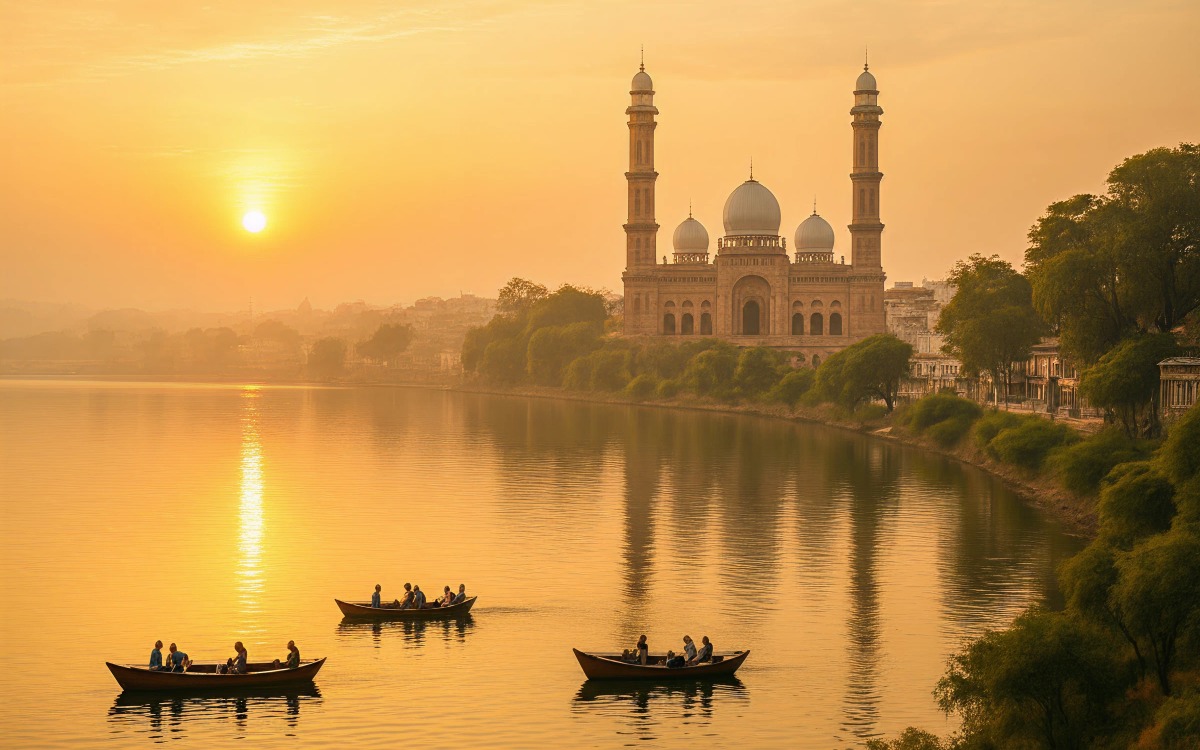
The two lakes, Upper Lake and Lower Lake, give the city an unusual serenity for its size. The lakeside promenades, especially at sunset, offer views across water to minarets and hilltops that feel more like a smaller, gentler city than a state capital of two million people.
Best time to visit: October to March. The winter light on the lakes is beautiful, and Bharat Bhavan’s outdoor performance season runs through these months.
6. Aurangabad
Beyond the gateway
Most visitors arrive in Aurangabad as a base for Ajanta and Ellora, the two cave complexes that represent perhaps the greatest surviving achievement of ancient Indian art. Ajanta’s painted caves, carved between the 2nd century BCE and 5th century CE, contain Buddhist murals of breathtaking beauty and complexity. Ellora’s rock-cut temples, spanning Buddhist, Hindu, and Jain traditions across a kilometre of basalt cliff, include the Kailasa Temple, a structure carved top-down from a single rock, equivalent in volume to the Parthenon.
But Aurangabad itself, often dismissed as a transit stop, rewards a slower visit. Bibi Ka Maqbara, built in 1660 by Aurangzeb’s son in imitation of the Taj Mahal as a tribute to his mother, is a more complicated and in some ways more interesting building than its model. Its four minarets and central dome are rendered in a mixture of lime plaster and marble that makes it luminous and slightly ghostly in the evening light. Daulatabad Fort, eight kilometres from the city, was once the capital of the Deccan Sultanate and remains one of the most formidable examples of medieval military architecture in the subcontinent.
The Himroo weaving tradition, a silk-and-cotton blend developed in the Mughal courts, is still practiced by artisan families in the old city. A visit to one of the remaining looms, where weavers produce the same patterns that were once sent to emperors, is a reminder that craft traditions outlast the courts that commissioned them.
Best time to visit: October to March. The caves are open year-round, but April to June is brutally hot, and some outdoor sites become uncomfortable. The cave murals at Ajanta are at their most visible in good, indirect winter light.
7. Nashik
Pilgrimage and pinot, an unexpected combination
Nashik holds two identities in productive tension. It is one of the four Kumbh Mela sites. The Godavari river ghats here draw millions of pilgrims every twelve years, and the ritual bathing at Ramkund Ghat is a daily practice that connects the city to a continuous thread of devotion stretching back millennia. The Panchavati area, associated with the Ramayana, is where Sita is believed to have been kidnapped by Ravana, and the temples and caves here have been drawing pilgrims since before the Common Era.
And yet Nashik is also the heart of Maharashtra’s wine country. The Sahyadri mountain range, the elevation, and the climate have produced vineyards that now export internationally. Sula, York, and Grover Zampa, the wineries clustered around Nashik, have created an entirely new form of tourism in a region better known for sadhus than sommeliers. The SulaFest, held in February, brings music and wine and an incongruously cosmopolitan crowd to the foothills of the Western Ghats.
The contrast is not a contradiction but character. Nashik is a city comfortable holding ancient and contemporary identities simultaneously, which is more or less the definition of a thriving cultural hub.
Best time to visit: February is ideal. SulaFest runs then, the wine harvest is recent, and the weather is perfect. October to March is generally best, avoiding the Godavari monsoon floods that can close the ghats.
8. Vadodara / Baroda
India’s most underrated arts city
Maharaja Sayajirao Gaekwad III was one of the most remarkable rulers in Indian history. In the late 19th and early 20th centuries, he introduced free and compulsory primary education, abolished child marriage, established a public library system, and built institutions that would shape Indian intellectual life for generations. He brought B. R. Ambedkar, who would go on to draft the Indian constitution, to Baroda on a scholarship.
The cultural institution he built that survives most completely is the Baroda Museum and Picture Gallery, which contains, improbably, in this mid-sized Gujarati city, paintings by Raphael, Titian, and Murillo alongside the finest collection of Mughal and Indian miniatures outside Delhi and London. The Maharaja Sayajirao University’s Faculty of Fine Arts has produced painters, sculptors, and printmakers who have shaped contemporary Indian art for five decades. Baroda is, without exaggeration, the city that trained modern Indian art.
The city itself, with wide tree-lined roads, Lakshmi Vilas Palace (which is four times the size of Buckingham Palace and is still the private residence of the Gaekwad family), and the Kirti Mandir royal cenotaphs, is a graceful place that moves at a pace its more famous neighbours have long abandoned.
Best time to visit: October to March for heritage walks and museum visits. The monsoon, from July to September, is gentle here and the gardens are at their lushest.
9. Kanpur
The Manchester of the East
Kanpur’s reputation is industrial, and its industrial heritage is exactly what makes it culturally interesting. At its peak in the early 20th century, it was one of the largest leather and textile manufacturing centres in Asia. The city’s tanneries, once supplying leather to the British Army and later to global markets, gave rise to a working-class culture and a labour movement that shaped the politics of the Gangetic plain for decades.
The 1857 sites are among the most historically charged in the country: Nana Rao Park, formerly Company Bagh; Sati Chaura Ghat; Massacre Ghat; and Kanpur Memorial Church. These are places where some of the most violent confrontations of the first Indian uprising against British rule played out. Visiting them requires a willingness to sit with complicated, unresolved history.
The city’s Phool Mandi, or flower market, on the banks of the Ganga at dawn, is one of those genuinely unrepeatable travel experiences: a spectacle of colour and commerce that has been happening every morning for longer than anyone can remember, connected to no particular landmark but to the daily life of a city that is much more than its reputation.
10. Jabalpur
The marble gorge the world forgot
Twenty-five kilometres from Jabalpur, the Narmada river passes through a gorge of white crystalline marble. At Bhedaghat, the cliffs rise 30 metres above the water, and the river runs between them milky and silent, reflecting the rock in a way that makes the whole place feel slightly unreal, too beautiful to be accidental. A boat ride through the gorge, particularly in full moonlight, is one of the most dramatic natural heritage experiences in India.
Above the gorge is the Chausath Yogini Temple, a 10th-century circular temple to 64 yoginis, open to the sky, on a hilltop looking over the Narmada. The Archaeological Survey of India believes it may have served as the model for the Indian Parliament building. Below the gorge is the Dhuandhar waterfall, where the Narmada drops and creates a permanent mist.
Jabalpur itself has a quiet, unhurried character: a former British cantonment town with wide roads, colonial churches, and a sense that it has been overlooked by the tourism industry in a way it doesn’t entirely mind. The Rani Durgavati Museum holds one of the finest collections of Chola and Pala period sculpture in central India.
Best time to visit: October to February for the gorge and falls. The monsoon, from July to September, swells the Narmada and closes the boat rides, but the falls are at their most spectacular.
11. Vishakhapatnam
Ancient shores, submarine museum, and a valley that rewards the detour
Vishakhapatnam, or Vizag to almost everyone who lives there, has one of India’s oldest ports and one of its most scenic coastlines. Rishikonda, Yarada, Rushikonda, and Ramakrishna Beach offer something genuinely rare: a major Indian city where the sea is not an amenity but a presence.
The INS Kursura Submarine Museum, a decommissioned Soviet-era submarine sitting on the beach, is one of the more unusual heritage sites in the country, allowing visitors to walk through the claustrophobic interior of a Cold War-era vessel that actually served in the Indian Navy. The adjacent war memorial is one of the best-maintained in India.
The Buddhist heritage of the region is substantial and underserved. Thotlakonda, an ancient Buddhist monastery complex on a hilltop above the sea, dates from the 3rd century BCE and commands views over the Bay of Bengal that make the archaeological significance feel almost secondary to the landscape.
Inland from the city, the Araku Valley, reached via one of the most scenic railway journeys in India, through 58 tunnels and across 84 bridges, is a tribal coffee-growing region in the Eastern Ghats where Adivasi cultural traditions and the landscape reward a two-day stay.
Best time to visit: October to February. Avoid June to September, when the Bay of Bengal cyclone season can disrupt travel. The Araku Valley is particularly beautiful in October, after the monsoon greens everything.
12. Solapur
Textile craft and Deccan devotion
Solapur sits at the edge of Maharashtra’s Deccan plateau, a flat, sun-baked city with two things that distinguish it from every other city of similar size in India. The first is the Solapur chaddar, a handwoven cotton textile made on traditional pit looms by weaving communities that have practiced this craft for generations. The particular quality of the Solapur chaddar, its texture, its durability, and its distinctive geometric borders, has earned it a Geographical Indication tag, placing it alongside Kanjeevaram silk and Pashmina wool as a protected Indian craft tradition.
The second is the Siddheshwar Temple, set on the island of Siddheshwar Lake in the heart of the city. The temple complex, dedicated to a saint-poet of the Lingayat tradition, reflects in the water and can be circumambulated along a lakeside path that fills with pilgrims and evening walkers in equal measure. The Siddheshwar Fair, held every winter, draws over a million pilgrims to a city that is otherwise rarely visited.
13. Thane
Mumbai’s overlooked neighbour with its own story
Thane is where most people stop thinking about Thane and start thinking about Mumbai. That is a mistake. Thane, the city that sits at the head of Thane Creek, 35 kilometres from Mumbai, was a Portuguese settlement before the British arrived, and before that, a significant medieval trading post. Agashi Fort, Bassein’s Portuguese remains, and Kopineshwar Temple, dedicated to an incarnation of Shiva and built in the Hemadpanthi architectural style in the 12th century, are real and un-touristy heritage.
The city has 28 lakes within its limits, an extraordinary number for an urban area, and Upvan Lake is a pleasant walking destination that most Thane residents know and most visitors never find. Sanjay Gandhi National Park, accessible from Thane, contains the Kanheri Caves, over 100 Buddhist caves carved between the 1st and 10th centuries CE, set in forest that feels entirely remote despite being within the Mumbai Metropolitan Region.
Thane also has a proud and active Marathi theatre and literary culture, a reminder that Maharashtra’s cultural life does not begin and end in Mumbai.
14. Kalyan
A medieval port before Mumbai existed
Here is a fact that reframes the geography of the Mumbai region: Kalyan was a significant port, trading post, and administrative centre long before Mumbai was anything other than a cluster of fishing villages. Arab traders passed through Kalyan in the 8th and 9th centuries. The Portuguese controlled it in the 16th century. Chhatrapati Shivaji Maharaj captured Kalyan in 1658 and used it as a base for the Maratha navy’s expansion into coastal trade and warfare.
The Kalyan Fort, the step-wells, the Durgadi Fort with its temple within a fort, seized from the Portuguese and converted into a Hindu temple by the Marathas, and the old Muslim quarter with its mosques and havelis carry this layered history in their stones. Walking the old city is walking through six centuries of trade, conflict, and cultural exchange.
Kalyan is not a destination in the conventional sense. There are no hotels geared to heritage tourism, and no curated walking tour industry. That is partly what makes a visit there feel like an actual discovery rather than a managed experience.
15. Howrah
The other side of the bridge
Millions of people cross the Howrah Bridge every day. Almost none of them are going to Howrah as a destination. They are going to Kolkata, and Howrah is what they pass through. This is unjust to a city that has its own substantial claims on the visitor’s attention.
The Indian Botanic Garden in Howrah is home to the Great Banyan Tree, a single specimen of Ficus benghalensis that has been growing for over 250 years and now covers approximately 1.5 hectares. With 3,772 aerial roots and a circumference of nearly half a kilometre, it is the largest tree in the world by area and is, in a very real sense, a forest that is also one tree. Its capacity to astonish has not diminished with familiarity.
Howrah’s jute mill heritage, the industry that made Bengal the world’s jute capital in the 19th and early 20th centuries, is one of the great untold stories of Indian industrial history. The derelict mills along the Hooghly, now slowly being reclaimed by vegetation, are haunting reminders of the scale of what was built and what was lost. Howrah Station itself, one of the busiest railway stations in the world and architecturally among the most interesting, is a heritage monument hiding in plain sight.
Best time to visit: October to February. The monsoon in Kolkata and Howrah is famously heavy and can cause significant flooding; visit in winter for the best experience.
16. Faridabad
The craft fair that defines the city
Faridabad’s industrial profile, automotive parts, chemicals, textiles, does not suggest a cultural destination. But every February, the city becomes something else entirely. The Surajkund Crafts Mela, held at the ancient reservoir of Surajkund, built in the 10th century by a Tomar king, for fifteen days, is one of Asia’s largest craft fairs: over 300 artisans from across India and several neighbouring countries, representing every major handicraft tradition from Madhubani painting to Naga woodwork to Rajasthani block printing.
The fair rotates each year between a different Indian state and country as the featured theme, meaning each edition is genuinely different. The evening cultural programmes, folk music, classical dance, and regional theatre, run on an outdoor stage against the backdrop of the illuminated Surajkund reservoir, which is one of the more quietly dramatic settings for a performance anywhere in north India.
Outside of the Mela, the Surajkund reservoir and its surrounding parkland are worth a visit. The 10th-century stepped tank, dry for most of the year, gives a sense of the scale of medieval water engineering in this part of the Gangetic plain.
17. Meerut
Where 1857 began
On 10 May 1857, Indian soldiers of the Bengal Army stationed at Meerut refused to use cartridges they believed were greased with animal fat, offensive to both Hindu and Muslim soldiers, and revolted against their British officers. The uprising spread from Meerut to Delhi within 24 hours, and from Delhi across much of north and central India. What the British called the Sepoy Mutiny and Indians call the First War of Independence began in this city.
The physical traces of 1857 are preserved in Meerut with unusual completeness. St. John’s Church, built in 1819 and one of the earliest colonial churches in north India, contains the graves of British officers killed in the uprising. The Shaheed Smarak, or Martyrs’ Memorial, stands where the first shots were fired. The cantonment, still in use as a military area, retains its colonial spatial logic almost intact.
The city’s older heritage includes the Augarnath Temple and the Jama Masjid, and Meerut has long been one of the most important centres for the manufacture of sports goods, particularly cricket bats and equipment, a more recent tradition that reflects the city’s industrial character.
18. Ghaziabad
Gateway to the Doab
Ghaziabad’s reputation is entirely as a satellite city: the edge of Delhi, the place you pass through. But the city sits at the western edge of the Doab, the fertile land between the Ganga and Yamuna rivers that was one of the most productive and strategically significant agricultural territories in the medieval world. The city itself was founded in 1740 by a Mughal official, Ghazi-ud-Din, and its old quarters retain traces of that Mughal administrative heritage.
The Dudheshwar Nath Temple, set on the banks of the Hindon river, is a significant pilgrimage site with a continuous history of worship. The historic Raj Nagar area connects the modern city to a more stratified urban past. More significantly, Ghaziabad’s position as the entry point to the Doab means that within an easy distance lie some of the most important Mughal and pre-Mughal heritage sites in Uttar Pradesh.
Ghaziabad rewards the traveller willing to look for its character beneath the surface of its satellite-city reputation. It is a city that has been underestimated for so long that it has largely stopped trying to correct the impression.
19. Pimpri-Chinchwad
Buddhist caves and an industrial township
Twenty kilometres from the centre of Pune, and often treated as its industrial suburb, Pimpri-Chinchwad has two cultural claims that have nothing to do with each other and everything to do with why the city is more interesting than it appears.
The first is the Bhaja Caves, a group of 22 rock-cut Buddhist caves carved into a basalt cliff in the 2nd century BCE, one of the oldest cave complexes in the Deccan. The chaitya, or prayer hall, at Bhaja is one of the earliest examples of a wooden architectural form translated into stone. The architects mimicked the arched wooden construction of earlier timber buildings in the durable medium of basalt, creating a record of a building type that would otherwise have entirely disappeared. The vihara caves and the unusual frieze showing figures that may represent scenes from the Ramayana or early court life add layers of interpretive mystery. Most visitors to Pune go to Karla Caves, the more famous nearby complex, and miss Bhaja entirely.
The second is the TELCO township, the planned residential community built by Tata Engineering and Locomotive Company, now Tata Motors, for its workers in the mid-20th century. Modelled on progressive ideas about the relationship between industry and living, with schools, hospitals, parks, and community spaces built into the plan, it represents a particular moment in Indian industrial and social history that has largely been forgotten in the rush to evaluate cities by their current output rather than their historical formation.
20. Varanasi
The city that turns faith into daily weather
Varanasi is not simply old. It is layered with ritual, trade, and memory in a way that makes chronology feel too neat for the place. The ghats are the city’s great public stage, where cremations, bathers, boatmen, priests, students, and sadhus all occupy the same riverbank without ever collapsing into a single story. The Ganga here is not scenery; it is the axis around which the city continues to turn.
The other Varanasi is the city of silk and craft. Banarasi weaving has been tied to the city for centuries, with Persian, Mughal, and local influences woven into its brocades and zari work. Walk through the lanes behind the ghats and you find a city of looms, temples, courtyards, and tea stalls that has survived by adapting without ever looking modern in the usual sense.
Best time to visit: October to March. The winter light on the river and the ghats is at its best, and the heat does not flatten the city’s rhythms.
21. Lucknow
Where etiquette became a culture
Lucknow is the city of adab, a place where refinement is not decoration but social grammar. Its Awadhi legacy shaped a court culture that survives in its language, its food, its architecture, and its deep love of elegant performance. The Bara Imambara, Chota Imambara, and Rumi Darwaza are not just monuments; they are expressions of a civic imagination that valued grandeur without losing its poise.
Then there is the food. Lucknow’s kebabs, biryanis, and breads are not only famous, they are inseparable from the city’s identity. Chikankari embroidery adds another layer, turning cloth into an extension of the same patience and delicacy that defines the city’s best cooking and conversation.
Best time to visit: October to March. The climate is gentler, and the city’s formal beauty reads better in soft winter light.
22. Puri
Pilgrimage with the sea at its edge
Puri is one of those rare places where devotion, craft, and landscape all feel mutually necessary. The Jagannath Temple dominates the city’s spiritual life, but Puri is not only about the temple complex itself. The annual Rath Yatra turns the city into a vast moving ritual, and the temple’s kitchen, one of the largest in the world, gives everyday form to a sacred economy that has endured for centuries.
The city also connects strongly to Odisha’s artistic traditions. Temple rituals helped shape Odissi dance and music, while nearby craft villages carry forward scroll painting, applique, and stonework traditions that are tied to the devotional world of the coast. Add the Bay of Bengal, and Puri becomes something unusual: a pilgrimage town that is also a seaside city with a distinct rhythm of its own.
Best time to visit: October to February. The weather is more comfortable, and the sea breeze makes the city especially pleasant on foot.
23. Imphal
A royal city at the edge of the hills
Imphal is a city of memory, but not the frozen kind. Kangla Fort, once the royal seat of the Meitei kings, anchors a historical landscape that stretches back through centuries of Manipuri polity and belief. The city carries the marks of monarchy, colonial disruption, and wartime history, yet it remains deeply local in texture, with markets, dance, and cuisine still rooted in older forms of life.
What makes Imphal especially compelling is the way it links the city to the wider landscape of Manipur. Loktak Lake, with its floating phumdis, gives the region a visual identity unlike anywhere else in India. The city’s cultural life, including Manipuri dance and its distinctive martial and ritual traditions, gives it a depth that most first-time visitors do not expect.
Best time to visit: October to March. The skies are clearer, and travel around the valley is easier.
24. Shillong
The hill city that found its voice in music
Shillong has always felt slightly apart from the India that most people imagine. Its colonial legacy, hilltop setting, and strong Khasi identity give it a character that is cooler, quieter, and more self-contained than the plains cities below. But its most distinctive modern identity is musical. Church choirs, school bands, rock groups, and a long openness to Western sounds have made Shillong one of India’s most enduring music capitals.
That musical life is not separate from the place. It grows out of the hills, the churches, the schools, and the social habit of performance that runs through local culture. Even without the music, Shillong would still be worth the detour for its climate, viewpoints, and slower hill-town rhythm. With it, the city feels almost like a small cultural republic of its own.
Best time to visit: October to May. The weather is pleasant for much of the year, though the monsoon brings heavy rain and dramatic skies.
25. Madurai
A temple city that never stopped living
Madurai is built around the Meenakshi Amman Temple, but the temple does not sit apart from the city as a monument. It is threaded through it. Streets, markets, festivals, processions, and daily worship all orbit a religious and urban core that has been active for more than two millennia. The result is a city that feels ceremonial without becoming static.
Madurai is also one of the great food cities of the south. Its idli, jigarthanda, paruthi paal, and street-side meals are part of a larger Tamil urban culture that prizes flavour, routine, and accessibility. The city’s old bazaars, palace remains, and literary associations add another layer, but the strongest impression is of a place that has kept its religious center alive without turning itself into a museum.
Best time to visit: November to February. The heat is otherwise severe, and walking the temple district is much more rewarding in cooler weather.
26. Mysuru
A city that still knows how to stage itself
Mysuru is one of India’s most graceful cities, and it has the rare advantage of having turned spectacle into civic tradition without losing its calm. The Mysore Palace is the obvious emblem, especially during Dasara, when the city becomes a vast illuminated pageant. But Mysuru’s appeal is broader than royal display. It is a city of gardens, clean boulevards, sandalwood, silk, and a courtly atmosphere that still shapes its public identity.
Its cultural life is unusually legible. The palace, the zoo, the markets, the crafts, and the surrounding institutions make Mysuru feel designed for attention rather than speed. It is also a city where the old and new remain comfortably adjacent, which is part of why it still feels hospitable rather than merely historic.
Best time to visit: September to March. Dasara is the peak season, but the city remains pleasant well beyond the festival.
27. Hampi
Ruins with the scale of a vanished empire
Hampi is not a ruin in the narrow sense. It is a landscape of memory made visible, the remains of the Vijayanagara Empire spread across granite hills, riverbanks, temples, markets, and royal enclosures. The site feels both vast and intimate: vast in its architectural ambition, intimate in the way its stones still hold the outline of processions, trade, devotion, and court life.
What survives at Hampi is not just grandeur but invention. The Vitthala Temple, stone chariot, market streets, and scattered monolithic forms show how thoroughly the Vijayanagara world fused architecture, religion, commerce, and landscape. It is one of the few places in India where the scale of an empire can still be read directly in the ground beneath your feet.
Best time to visit: October to February. The heat is punishing for much of the year, and the winter months let the site breathe.
The cities in this list are not interchangeable. They do not share a type or a scale or a character. What they share is the quality of rewarding attention, of having more to offer than their national profile suggests, of being the kind of place where a traveller willing to slow down and look carefully will find something genuine.
India is large enough that you can spend a lifetime visiting it and still find cities you have never heard of that have been continuously inhabited for 2,000 years. That is not a problem to be solved by a better itinerary. It is an invitation.
The 27 cities above are a beginning.