Across continents, certain cities are defined not by skylines or monuments, but by their bazaars; dense, layered marketplaces that dictate how the city breathes, trades, and interacts. These are not just places to shop; they are systems of movement, culture, and memory. From the Persian heartlands to the Indian subcontinent and North Africa, bazaar cities reveal how commerce can shape identity over centuries.
Tehran, Iran
In Tehran, the Grand Bazaar of Tehran operates as a city within the city. It is an intricate network of corridors that stretches for kilometres. What sets it apart is its organisation. Each section is dedicated to a specific trade—carpets, gold, spices, textiles—creating a highly specialised commercial ecosystem. The architecture is functional yet atmospheric: vaulted brick ceilings regulate temperature, while narrow lanes control movement and crowd flow.
Beyond commerce, the bazaar has historically been a centre of political and social influence. Merchants here were deeply involved in Iran’s economic and civic life, and the space often doubled as a forum for discussion and mobilisation. Today, while modern retail exists elsewhere in Tehran, the bazaar remains a place where traditional bargaining, long-standing trade relationships, and generational businesses continue to define the rhythm of daily life.
Istanbul, Turkey
Istanbul represents the grand, imperial scale of bazaar culture. The Grand Bazaar Istanbul is among the largest covered markets in the world, with thousands of shops arranged along intersecting streets. Nearby, the Spice Bazaar reflects the city’s historic role in global spice trade routes.
What visitors encounter here is a layered experience. Ornate ceilings, hanging lanterns, and a blend of traditional crafts with contemporary retail. The bazaar is structured but not rigid; it accommodates both wholesale traders and casual shoppers. Historically, it was integrated with caravanserais that hosted travelling merchants, linking Istanbul directly to trade networks across Asia and Europe. Today, while tourism plays a significant role, the bazaar still retains its commercial backbone, making it one of the few places where historical trade infrastructure continues to function at scale.
Marrakech, Morocco
In Marrakech, the souks unfold as a sensory maze radiating from Jemaa el-Fnaa. Unlike the structured bazaars of Persia or Turkey, Marrakech’s markets are organic and immersive. Narrow alleys twist unpredictably, opening into pockets of activity. Textiles in one lane, metalwork in another, spices piled high in vivid displays.
The experience here is as much about atmosphere as it is about trade. Street performers, food vendors, and artisans operate side by side, blurring the line between marketplace and public square. While tourism has influenced what is sold, traditional crafts such as leatherwork and lantern-making remain central. Bargaining is expected, and interactions are direct and animated. Marrakech’s souks demonstrate how a bazaar can evolve into a cultural performance space without losing its commercial roots.
Cairo, Egypt
Cairo offers one of the oldest continuous bazaar traditions through Khan el-Khalili. Established in the 14th century, this market sits at the heart of Islamic Cairo, surrounded by mosques and historic institutions. The bazaar’s layout reflects the classical Islamic urban model, where commerce, religion, and education are closely intertwined.
Visitors can expect a dense concentration of traditional goods—brass lamps, perfumes, textiles, and handcrafted souvenirs. The architecture, with its arches and narrow passageways, creates a sense of enclosure that intensifies the experience. Unlike more tourist-driven markets, Khan el-Khalili still supports local trade networks, with many operating family-run businesses passed down through generations. It remains a living marketplace rather than a curated attraction.
Jaipur, India
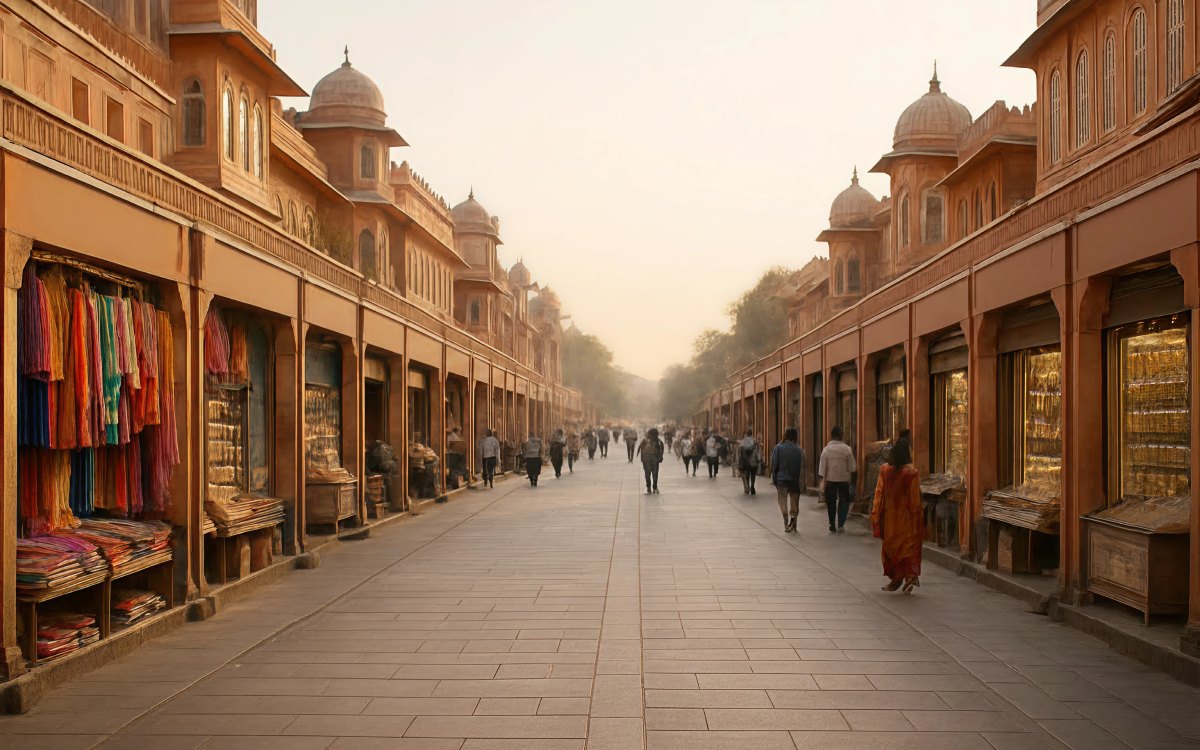
Jaipur presents a more deliberate interpretation of the bazaar city. Unlike organically developed markets, Jaipur’s bazaars were planned as part of the city’s 18th-century design. Markets such as Johari Bazaar and Bapu Bazaar are laid out along broad, straight roads, with uniform shopfronts and designated areas for specific trades.
This structure makes the experience more navigable while retaining the intensity of traditional commerce. Jewellery, textiles, and handicrafts dominate, with entire stretches dedicated to a single category of goods. The visual identity of pink facades and symmetrical layouts adds to the sense of cohesion. Jaipur demonstrates how bazaar principles can be adapted into urban planning, creating a system that is both functional and aesthetically consistent.
Hyderabad, India
In Hyderabad, the bazaar is deeply tied to Indo-Persian heritage. Markets like Laad Bazaar near the Charminar reflect a synthesis of Persian market logic and Indian street commerce. Narrow lanes, specialised goods, and dense foot traffic define the experience.
What stands out here is continuity. Pearls, bangles, attar (perfume), and textiles are not just tourist items. They are part of long-standing trade traditions. The bazaar remains embedded in daily life, serving local residents as much as visitors. The influence of Persian urban culture is visible in the spatial organisation and the emphasis on specialised trades, but it is adapted to Indian conditions—more open, more chaotic, and more integrated with the surrounding city.
Samarkand, Uzbekistan
Samarkand represents the Silk Road’s bazaar tradition at its most historically significant. The Siab Bazaar sits close to the Registan, linking trade with monumental architecture.
The market is open, vibrant, and deeply tied to agricultural trade where fresh produce, nuts, spices, bread, and textiles dominate. Unlike enclosed Persian bazaars, Samarkand’s market reflects Central Asia’s openness, both spatially and culturally. It remains a crucial node of local commerce rather than a purely touristic attraction.
Bangkok, Thailand
Bangkok offers a different evolution of the bazaar concept. Markets like Chatuchak Weekend Market and the city’s floating markets demonstrate how traditional trade adapts to modern urban life.
Visitors encounter a sprawling, less structured environment where street food, clothing, crafts, antiques, and everyday goods coexist. The experience is more fluid than classical bazaars. It is less segmented and more dynamic but still rooted in the same principles of dense commerce and social exchange. Bangkok shows how the bazaar model can expand and modernise without losing its core identity.
Despite regional differences, bazaar cities share a common framework: trade organised by specialisation, architecture adapted to climate and crowd flow, and a social structure that extends beyond buying and selling. Whether in Tehran’s disciplined corridors or Hyderabad’s vibrant streets, the bazaar remains a space where commerce and culture are inseparable; shaping not just the economy, but the identity of the city itself.